
Listen to this Article
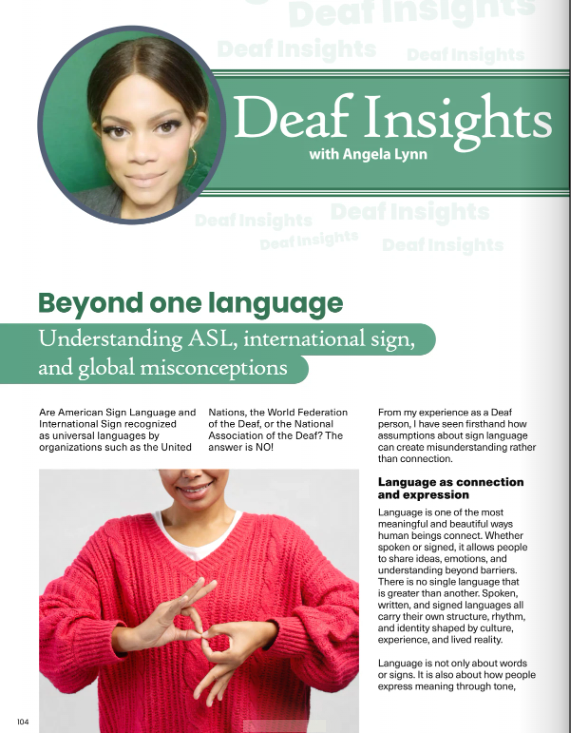
Beyond One Language: Understanding ASL, International Sign, and Global Misconceptions
Are American Sign Language and International Sign recognized as universal languages by organizations such as the United Nations, the World Federation of the Deaf, or the National Association of the Deaf? The answer is NO!
From my experience as a Deaf person, I have seen firsthand how assumptions about sign language can create misunderstanding rather than connection.
Language as Connection and Expression
Language is one of the most meaningful and beautiful ways human beings connect. Whether spoken or signed, it allows people to share ideas, emotions, and understanding beyond barriers. There is no single language that is greater than another. Spoken, written, and signed languages all carry their own structure, rhythm, and identity shaped by culture, experience, and lived reality.
Language is not only about words or signs. It is also about how people express meaning through tone, movement, and emotion. In spoken language, tone and pronunciation shape how a message is received. In sign language, movement, facial expression, and visual clarity bring language to life. Some forms may feel more fluid, others more direct, yet all are valid. Language, in all its forms, reflects human connection.
Global Perspectives and Misconceptions
Through my own research and conversations with people from Canada, Ecuador, India, Malaysia, and the United States, I found a range of perspectives. Some people felt that American Sign Language or International Sign could serve as a universal system, while others felt differently. These mixed viewpoints reflect how complex and layered this discussion is within the global Deaf community.
Across cultures, people naturally exchange languages. Spoken languages borrow words and expressions from one another. The same occurs in sign languages, where people may adapt or share signs when communicating across borders. This exchange supports understanding, but it does not replace a community’s own language. It creates a bridge.

Historical Development of ASL
American Sign Language developed through a blending of systems rather than a single origin. Early Deaf communities in the United States used home signs and local communication methods. A meaningful example can be seen in Martha’s Vineyard, where Deaf and hearing people communicated without barriers, creating a natural sense of belonging and shared understanding.
In the early nineteenth century, Thomas Hopkins Gallaudet and Laurent Clerc played a significant role in shaping what became American Sign Language. Through their work, elements of French Sign Language were introduced and blended with existing communication systems, forming a structured and recognized language.
Linguistic Foundations
American Sign Language is recognized as a complete language because it has been thoughtfully studied across key linguistic areas such as morphology, phonology, semantics, and syntax.
The work of William C. Stokoe, a hearing professor at Gallaudet University in Washington DC, is a foundational contribution. His research demonstrated that ASL is a complete language comparable to spoken languages, with structure and depth developed through years of linguistic study. This also opens the door for other Deaf communities to continue developing and studying their own sign languages as complete and meaningful languages within their own cultures.
In contrast, International Sign does not have the same level of standardized linguistic structure or consistent academic research. It functions as a flexible communication system rather than a fully established language. This difference may lead some people to assume ASL is universal, but visibility does not equal global recognition.
International Sign and Its Role
International Sign is not a full or official language. It is a flexible communication system used primarily at international events, combining gestures, shared signs, and visual understanding. Its form varies depending on the participants and context.
Organizations such as the United Nations, the World Federation of the Deaf, and the National Association of the Deaf do not recognize any single global sign language. Instead, they support national sign languages, each with its own grammar, cultural foundation, and identity.

Bilingual Communication and Literacy
Bilingual communication can be a strength when languages are used with clear roles. A primary language provides the foundation for literacy, identity, and expression, while secondary languages support broader communication. To help both hearing and Deaf people understand, it may be helpful to consider that access to language is not always the same for everyone. Many hearing people naturally grow up with full access to spoken language, while some Deaf people may experience barriers, especially when literacy is based on a spoken language that is not their first language. For many Deaf people, sign language is their first language and their true mother tongue.
This is one of the reasons why organizations such as the United Nations, the World Federation of the Deaf, and the National Association of the Deaf approach global language discussions with care.
For example, imagine a Deaf person living in Ecuador. They may grow up learning Spanish but may not always have full access to formal sign language education. If they are then expected to learn English and American Sign Language as well, it can become overwhelming and affect literacy development.
There is nothing wrong with learning additional languages. However, it is important to respect each language in its own space rather than blending them in ways that create confusion.
Looking Ahead
While English is widely used around the world, it is not officially designated as a single global primary language. The same applies to sign languages. American Sign Language is not a global language, and International Sign is not a universal language.
Looking ahead, communication may continue to evolve. With advancements in technology and global interaction, ideas around shared language may expand. However, at present, there is no confirmed universal spoken or signed language.
Language is ultimately a shared human experience. It is how people connect, express, and understand one another.
As we reflect on language and communication, it becomes clear that no single language can represent everyone.
Through my work with Project Belonging, communication helps people feel seen, valued, and understood.
As communication continues to evolve, there is an opportunity to move toward a more inclusive world, where language becomes a bridge rather than a barrier.
To learn more about Project Belonging, please visit www.theangelalynnshow.com
For speaking engagements or to connect, please reach me at
🌻 Sunflowerly yours, Angela Lynn 🌻