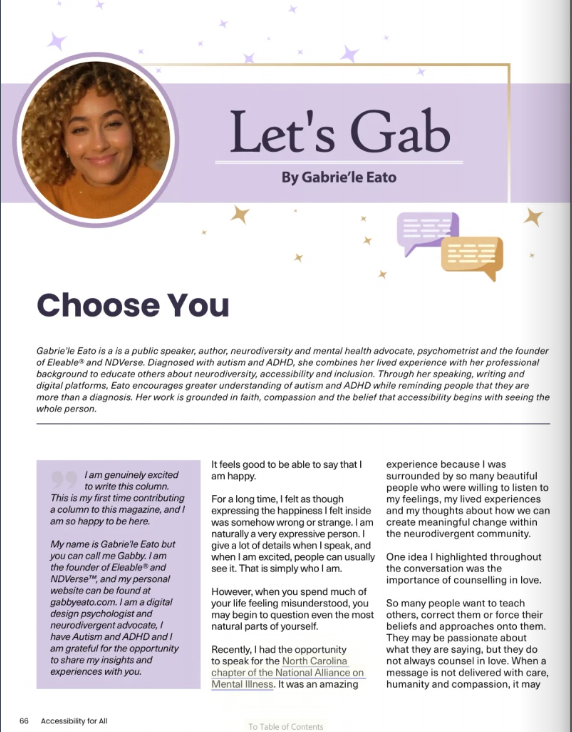
By Gabrie’le Eato

Listen to this Article

I am genuinely excited to write this column. This is my first time contributing a column to this magazine, and I am so happy to be here.
My name is Gabrie’le Eato but you can call me Gabby. I am the founder of Eleable® and NDVerse™, and my personal website can be found at gabbyeato.com. I am a digital design psychologist and neurodivergent advocate. I have Autism and ADHD and I am grateful for the opportunity to share my insights and experiences with you.
It feels good to be able to say that I am happy.
For a long time, I felt as though expressing the happiness I felt inside was somehow wrong or strange. I am naturally a very expressive person. I give a lot of details when I speak, and when I am excited, people can usually see it. That is simply who I am.
However, when you spend much of your life feeling misunderstood, you may begin to question even the most natural parts of yourself.
Recently, I had the opportunity to speak for the North Carolina chapter of the National Alliance on Mental Illness. It was an amazing experience because I was surrounded by so many beautiful people who were willing to listen to my feelings, my lived experiences and my thoughts about how we can create meaningful change within the neurodivergent community.
One idea I highlighted throughout the conversation was the importance of counselling in love.
So many people want to teach others, correct them or force their beliefs and approaches onto them. They may be passionate about what they are saying, but they do not always counsel in love. When a message is not delivered with care, humanity and compassion, it may not be received in the way it was intended.
It is important to remember that there is a human being in front of you.
Not everyone sees life through the same lens that you do. That was something I found myself saying several times during my presentation. Too many people become trapped in the belief that the world operates only according to their worldview.
Every person has their own perspective. We all experience reality through our histories, identities, emotions, cultures, environments and minds.
Understanding this is not only about you. It is also about allowing other people to exist as themselves.
So what if I want to say that I am happy and express it outwardly? That is my way of showing joy. There is nothing wrong with being expressive.
For so long, I focused on how I appeared to other people when I should have been focusing inward and asking myself: How do I feel? Am I happy? Am I living in a way that is true to who I am?
Living a life in which people do not always understand you, your mannerisms or the way your mind works can teach you to people-please. You may constantly try to make others like you, approve of you or understand you.
But when you continually search outside yourself for acceptance, you can end up abandoning the person within.
If you truly want to work with your mind and not against it, you have to begin by loving yourself. You have to choose yourself.
It is not about constantly looking at other people and trying to please them or convince them to understand you every few seconds.
I used to explain everything.
I still analyze situations deeply, but there was a time when I tried to understand every single action, comment and change in another person’s behaviour. It became overwhelming, and it was not healthy.
Many neurodivergent people experience this kind of overanalysis. Sometimes, it comes from fear. You may feel that if you analyze every possible outcome, you can protect yourself from being misunderstood, rejected or hurt.
I know that was true for me. I wanted to feel completely covered and prepared. Eventually, I learned to let go.
I realized that my life is not about controlling every perception people have of me. It is about loving myself, loving God and remembering who I was created to be.
I believe that I am fearfully and wonderfully made in God’s image. I know that I have a good heart.
If someone is committed to misunderstanding me, that is something they have to work through. It is not always my responsibility to correct the version of me that another person has chosen to believe.
When you begin living this way, you allow yourself to express happiness freely. You realize that there is nothing wrong with showing joy. It is a beautiful thing to express yourself in ways that feel natural, as long as you are not harming anyone.
Being yourself does not hurt anyone.
When you are living in alignment with who you are supposed to be, you begin to understand that many of the opinions you once feared do not matter as much as you thought they did.
So many people focus on credentials, recognition and proving their worth.
I have more than 127,000 followers across social media, and I decided to conduct an experiment. I made everything private for a period of time and continued living my life, communicating with people and doing the work that mattered to me.
That experience helped me realize that none of those numbers determine who I am.
The most important thing is who you are in your heart.
You can have a billion followers, but if you mistreat people or become a menace to society, those followers cannot make you a good person.
Your heart, your character and the love you reflect into the world are what matter most.
I believe God is love, so I want my life to reflect love, kindness and compassion.
So many people become consumed by ego, status and vanity metrics. Social media, accomplishments and recognition can have value, but they only hold as much power as we give them. They should never become the foundation of our identity.
Real power is found in authenticity.
It is found in knowing who you are as a person, trusting your essence and standing confidently in your truth.
There was a time when I posted on TikTok regularly because I wanted approval. I wanted to prove my knowledge and receive certain things from other people.
Over time, however, I began to realize that what happens around us can sometimes reflect what is happening within us.
When I felt unworthy or lesser than others, I noticed that feeling reflected strongly outside of me. The very things I was seeking approval for would reveal the places within me that still needed love and healing.
But when I began to truly love myself, everything changed.
I stopped giving my attention to negative energy. I stopped focusing on people who were committed to holding onto a version of me they had created in their own minds. I stopped believing that I needed to prove my value to everyone.
I absolutely love myself now.
I am still human, so of course I struggle some days. Self-love does not mean that every day is perfect. It means that even on difficult days, I continue choosing myself.
Learning to focus less on what other people think has led me toward peace.
Accessibility is often discussed in terms of environments, technology and physical spaces. Those things are incredibly important.
But I also believe accessibility can begin within us. It can mean creating enough emotional room for people to communicate, move, think and express themselves differently.
Sometimes, accessibility is allowing another person to be happy in their own way.
Sometimes, it is counselling in love.
Sometimes, it is recognizing that a person’s value cannot be measured by followers, credentials, titles or public approval.
And sometimes, it is finally giving yourself permission to live as the person you have always been.
When you stop measuring yourself through other people’s approval and begin living from a place of love and purpose, you create a life that is genuinely your own.
Trust your essence.
Trust your truth.
Trust who God created you to be.
Choose you.
That authenticity will lead you wherever you are meant to go.
In this webinar, Autism. ADHD. More Than a Label – Gabby (partnership with NAMI North Carolina ) discusses how neurodivergence intersects with mental health and what family, friends, and providers should know about the people behind the diagnoses.
Watch the Webinar
Gabrie’le Eato is a is a public speaker, author, neurodiversity and mental health advocate, psychometrist and the founder of Eleable® and NDVerse. Diagnosed with autism and ADHD, she combines her lived experience with her professional background to educate others about neurodiversity, accessibility and inclusion. Through her speaking, writing and digital platforms, Eato encourages greater understanding of autism and ADHD while reminding people that they are more than a diagnosis. Her work is grounded in faith, compassion and the belief that accessibility begins with seeing the whole person.