
By Ed Carter

Listen to this Article
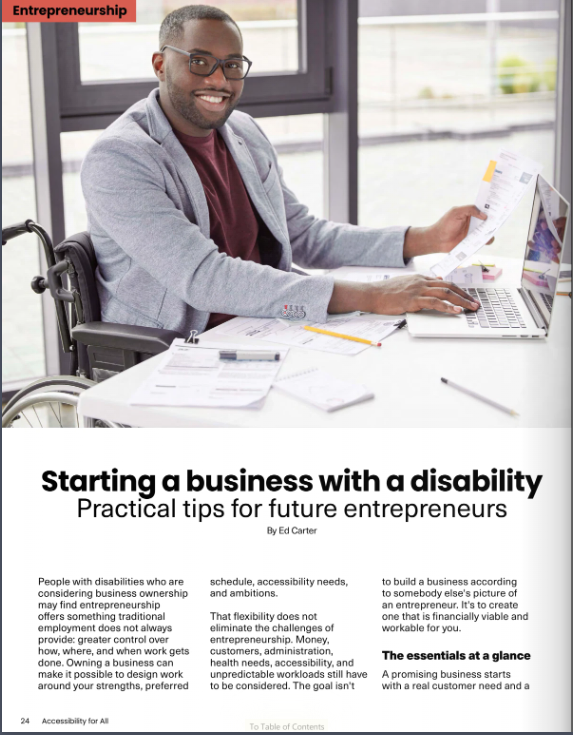
People with disabilities who are considering business ownership may find entrepreneurship offers something traditional employment does not always provide: greater control over how, where, and when work gets done. Owning a business can make it possible to design work around your strengths, preferred schedule, accessibility needs, and ambitions.
That flexibility does not eliminate the challenges of entrepreneurship. Money, customers, administration, health needs, accessibility, and unpredictable workloads still have to be considered. The goal isn’t to build a business according to somebody else’s picture of an entrepreneur. It’s to create one that is financially viable and workable for you.
The essentials at a glance
A promising business starts with a real customer need and a realistic way to meet it. Before spending heavily, test your idea, estimate startup and operating costs, identify accommodations or technology you may need, and learn how the business could affect your personal finances.
Most importantly, design your working conditions deliberately. Entrepreneurship gives you the opportunity to build accessibility into the business from day one rather than treating it as something to solve later.
Start small enough to learn
You don’t necessarily need a polished website, rented office, large inventory, or elaborate brand before discovering whether customers actually want what you’re selling.
A smaller test can answer that question more cheaply.
For example, someone planning a consulting business could first offer the service to a limited number of clients. A prospective retailer might test a small product range before purchasing significant inventory. This turns an intimidating question—”Will my business succeed?”—into a more useful one: “Will customers pay for this particular solution?”
Early testing can reveal pricing problems, accessibility barriers, workload issues, and customer expectations while they are still relatively inexpensive to address.
Build accessibility into the operating model
Your business should work on difficult days as well as ideal ones. Consider the physical, cognitive, sensory, communication, transportation, and scheduling demands involved in serving customers consistently.
Depending on your individual circumstances, useful adaptations might include:
- Assistive technologyor accessible software
- Flexible working hours and planned recovery time
- Remote meetings or a home-based workspace
- Automated scheduling, invoicing, and routine administrativeprocesses
- Contractors or employees for tasks that are difficult or unnecessarily draining
- Alternative communication methods for customers and suppliers

A practical pre-launch checklist
Before committing substantial money or time, work through these steps:
- Define the customer problemyour business will solve.
- Talk with potential customers and test whether genuine demand exists.
- Calculate one-time startup expenses and recurring monthly costs.
- Determine how much revenue the business needs to become sustainable.
- Identify accommodations, assistive technology, scheduling needs, or outside support you may require.
- Research the appropriate business structure, registrations, licenses, permits, insurance, and tax obligations.
- Create a simple system for bookkeeping and separating personal and business finances.
- Consider how self-employment income could interact with any benefits or assistance you currently receive, and seek qualified benefits guidance when necessary.
- Establish a backup plan for periods when you cannot work at your normal capacity.
The U.S. Small Business Administration recommends planning for matters including market research, startup costs, funding and a business plan before launch, followed by registration, permits, banking and insurance requirements.
Strengthening your business knowledge through education
Entrepreneurs quickly discover that running a company requires more than knowing how to make a product or provide a service. Pricing, bookkeeping, marketing, communication, budgeting, hiring, and management can all become part of the job.
Formal education is one way to strengthen those skills. A business-related degree in an area such as accounting, communications, business, or management can provide knowledge that applies to everyday entrepreneurial decisions. Online study may be particularly useful when flexibility matters because coursework can be fitted around business responsibilities and other commitments.
Prospective students comparing business programs can find more on hand here when exploring online business degree options.

Match the business to the life you want
A good opportunity on paper can still be a poor fit in practice. Look beyond potential revenue and examine what the business asks of you repeatedly.
| Consider | Questions worth asking |
|---|---|
| Workload | How many hours can I sustainably work? |
| Environment | Can I control noise, lighting, seating, location, or other important conditions? |
| Customers | Does serving this market require travel or communication methods that create barriers? |
| Operations | Which repetitive tasks could be automated, delegated, or simplified? |
| Finances | Can I handle inconsistent income while the company develops? |
| Continuity | What happens to customers if I unexpectedly need time away? |
This exercise can influence the business model itself. A service requiring constant appointments, for example, creates different demands from one built around asynchronous digital work.
A resource built for disability and entrepreneurship
The Job Accommodation Network’s entrepreneurship resources are worth bookmarking. JAN is an Office of Disability Employment Policy-supported service offering free, confidential guidance, including assistance related to self-employment and small-business development for people with disabilities. Its entrepreneurship materials cover areas such as business planning, financing strategies, accommodations, benefits planning, e-commerce, and disability-specific resources.
Frequently asked questions
Do I need a lot of money to become a business owner?
Not necessarily. Startup costs vary dramatically by business model. A home-based service business may require relatively little initial capital, while businesses involving premises, specialized equipment, employees, or inventory can require substantially more. Calculate costs for your specific idea rather than relying on a generic startup figure, and seek grants that can help you get a strong start.
Should I tell customers that I have a disability?
That is a personal and context-dependent decision. Some entrepreneurs make disability part of their public story or brand; others don’t. What matters operationally is creating reliable ways to deliver what customers have been promised.
Build a business that works for you
Business ownership can offer people with disabilities an opportunity to shape work around their capabilities, priorities, and preferred ways of working. Start by testing the smallest practical version of the idea, then improve it using what customers—and your own experience—teach you. A business worth building should support your livelihood without requiring you to imitate somebody else’s way of working.