Listen to this Article

At the funeral of a woman who had received hospice care, her family expressed their tearful gratitude to the man who had donated a toilet seat lift for her use. The device had helped the woman continue using the toilet independently near the end of her life. Without it, the next step would have been a bedpan. To her family, the toilet seat lift had offered something far more significant than assistance with sitting and standing. During a dark and difficult time, it had helped her retain her dignity.
The donor later described the family’s reaction in an email to SedMed founder Jeremy Bronen. The message now hangs in the company’s office as a reminder of the people the product was created to support. “That’s why we do what we do,” Bronen says.
People rarely consider what it means to lose the ability to use the bathroom alone. For someone who cannot easily lower themselves onto the toilet or stand up afterward, the experience can bring pain, fear and dependence into one of life’s most private moments. It can mean being naked in the hands of a stranger or worrying that a family member providing help may be injured. These are realities people often avoid discussing, even when they urgently need support. “Toileting is taboo,” Bronen says. “It’s one of the more intimate things we do as humans, but we try to protect our privacy and feel dignified.” That private and often overlooked struggle would eventually shape Bronen’s career, although it was not a problem he had initially set out to solve.
His path to this work began in Connecticut, where he watched his father, a neuroradiologist, help and care for people. His father also had a workshop, which sparked Bronen’s fascination with tinkering, building and taking things apart to understand how they worked. By his teenage years, those interests had become a passion, eventually leading him to study mechanical engineering at the University of Connecticut.
His exposure to his father’s work in medicine and his own love of building things came together during his final engineering capstone project. Bronen was assigned to work with a man who had developed the concept for an electric toilet lift after watching an older woman he called Grandma Grace struggle to use the bathroom and move around her home following a stroke. Her experience became the motivation for creating a device that could help.
Bronen’s first response to the assignment was hardly enthusiastic. A project involving toilets was not what he had imagined. But the more he learned, the less he could dismiss it. He heard about bathroom falls, surgeries and health-care workers getting injured from lifting patients. Most of all, he began to understand the emotional consequences of being unable to complete an activity of daily living alone.
“I really would say I fell in love with the problem more than anything,” he says. “It was a massive unmet need.”
Understanding that need also required Bronen to confront the limits of his own perspective. He was an able-bodied university student designing for people whose experiences he did not share. And he could not decide from behind a desk what would make a device useful, comfortable or dignified. “True innovation does not come from an office and a whiteboard or a laptop,” he says. “It comes from being out talking to people and hearing their experiences and their stories.”
Bronen brought prototypes to potential users and asked what they loved, what they hated and how the design could improve. The lift went through 15 versions, shaped by what people said they needed. Messages from users kept the purpose behind the work in focus and that commitment to helping people retain as much independence as possible influenced a key design decision.
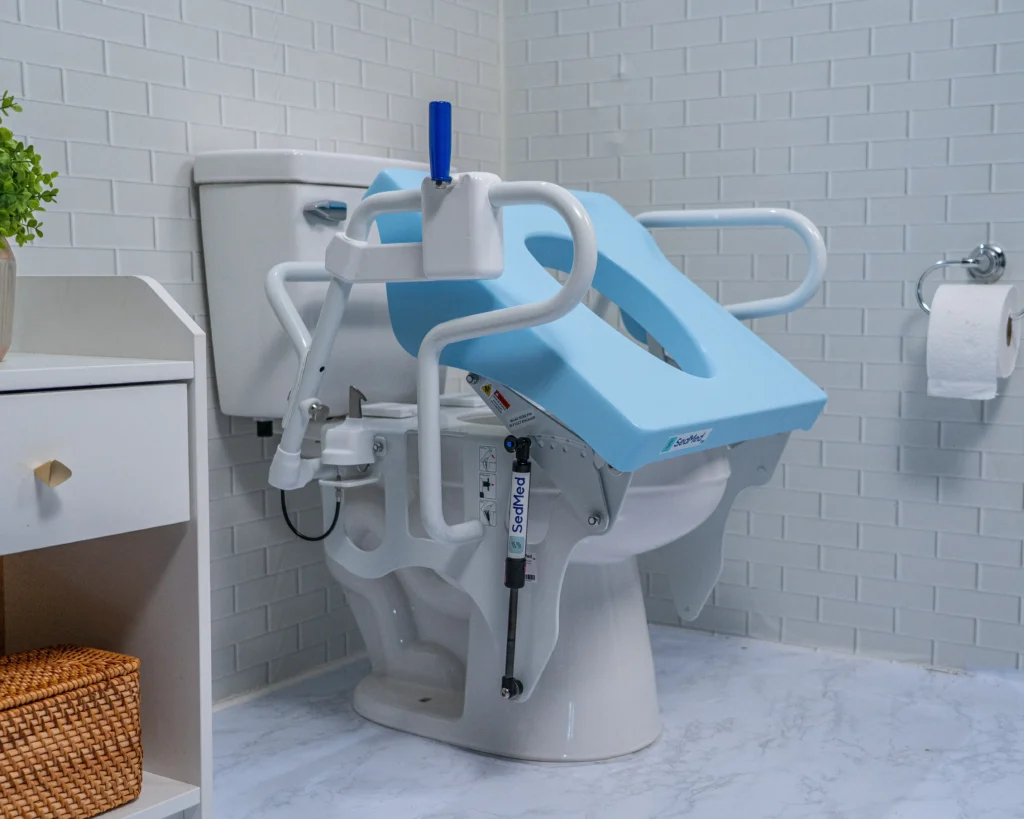
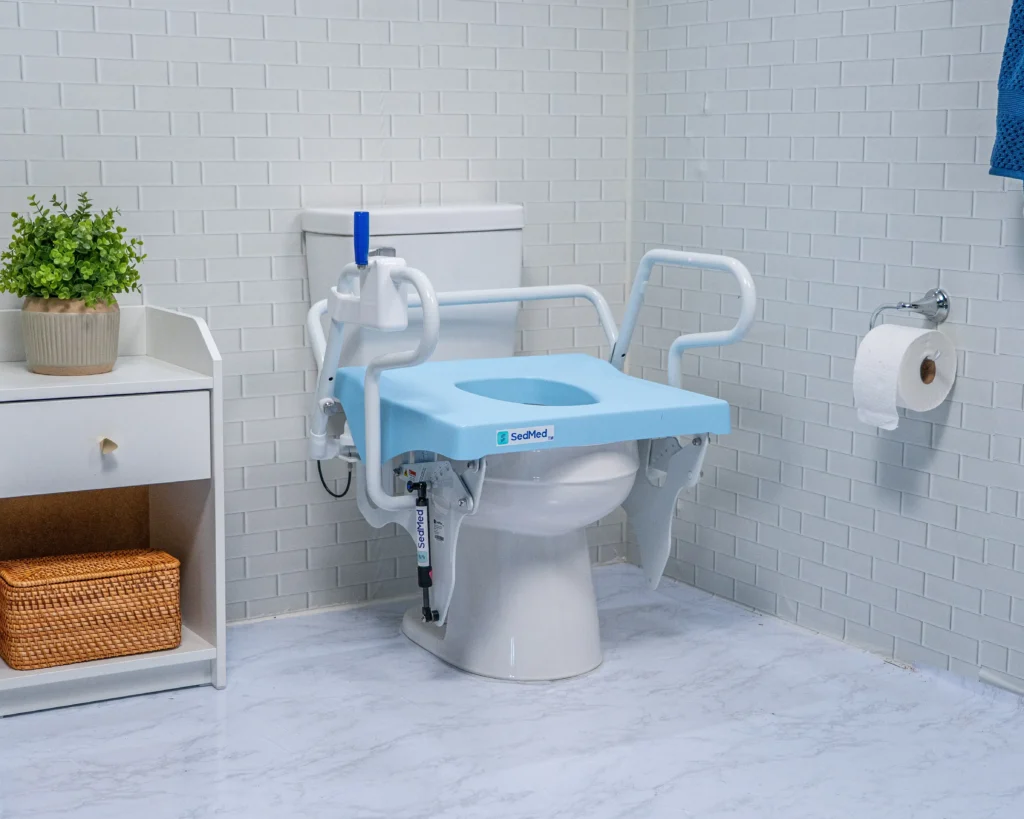
Rather than lifting someone entirely, SedMed’s non-electric toilet seat lift assists people who can participate in sitting and standing but need additional support. A gas spring slows the descent and helps the person stand, providing assistance equivalent to as much as 80% of their weight. The amount can be adjusted and gradually reduced as strength returns. Because the device provides a boost rather than a full lift, people can continue using their own muscles when possible.
When someone needs help sitting down on or standing up from the toilet, the physical demands of providing that assistance can take a toll on family members and health-care workers. Bronen recalls the wife of a man with Parkinson’s disease who tore her rotator cuff while lifting her husband from the toilet. Health-care workers have also described the strain placed on their backs while repeatedly helping patients. These injuries may not always lead to a formal workplace claim, he says, but that does not mean they are not happening.
Bathroom safety is often addressed with a grab bar or raised toilet seat, but Bronen argues that these additions do not resolve every sit-to-stand difficulty. A grab bar may offer something to catch or pull against, but it can be awkward and place more demand on one arm.
Those limitations point to a broader reality. No single device can work for every body or every circumstance, and Bronen is candid that SedMed is no exception. Feedback from people whose needs are not met by the current design helps him consider what future products may need to address. When SedMed is not a suitable option, Bronen says he has recommended other products that may better meet the person’s needs. “We’re all in this together,” he says.
That same people-first approach shapes how Bronen talks about bathroom support. He believes these conversations should begin with compassion, empathy and vulnerability. He openly calls himself “the toilet man” and sometimes uses humour to lessen the discomfort surrounding the subject. But behind the humour is a serious conviction that disabled people and older adults should not be made to feel different or ashamed because they require assistance.
Stigma surrounding the need for assistance is not limited to toileting. People may resist a walking stick or another assistive device because accepting it can feel like admitting they are dependent, old or somehow diminished. Bronen wants to replace that perception with a more compassionate understanding. “Just because you might need or greatly benefit from an assistive device does not mean you’re broken,” he says. “It’s just self-care.”
By addressing a part of daily life that is often left unspoken, SedMed is challenging people to think differently about assistance. In the bathroom, as elsewhere, the right support can preserve independence rather than diminish it.